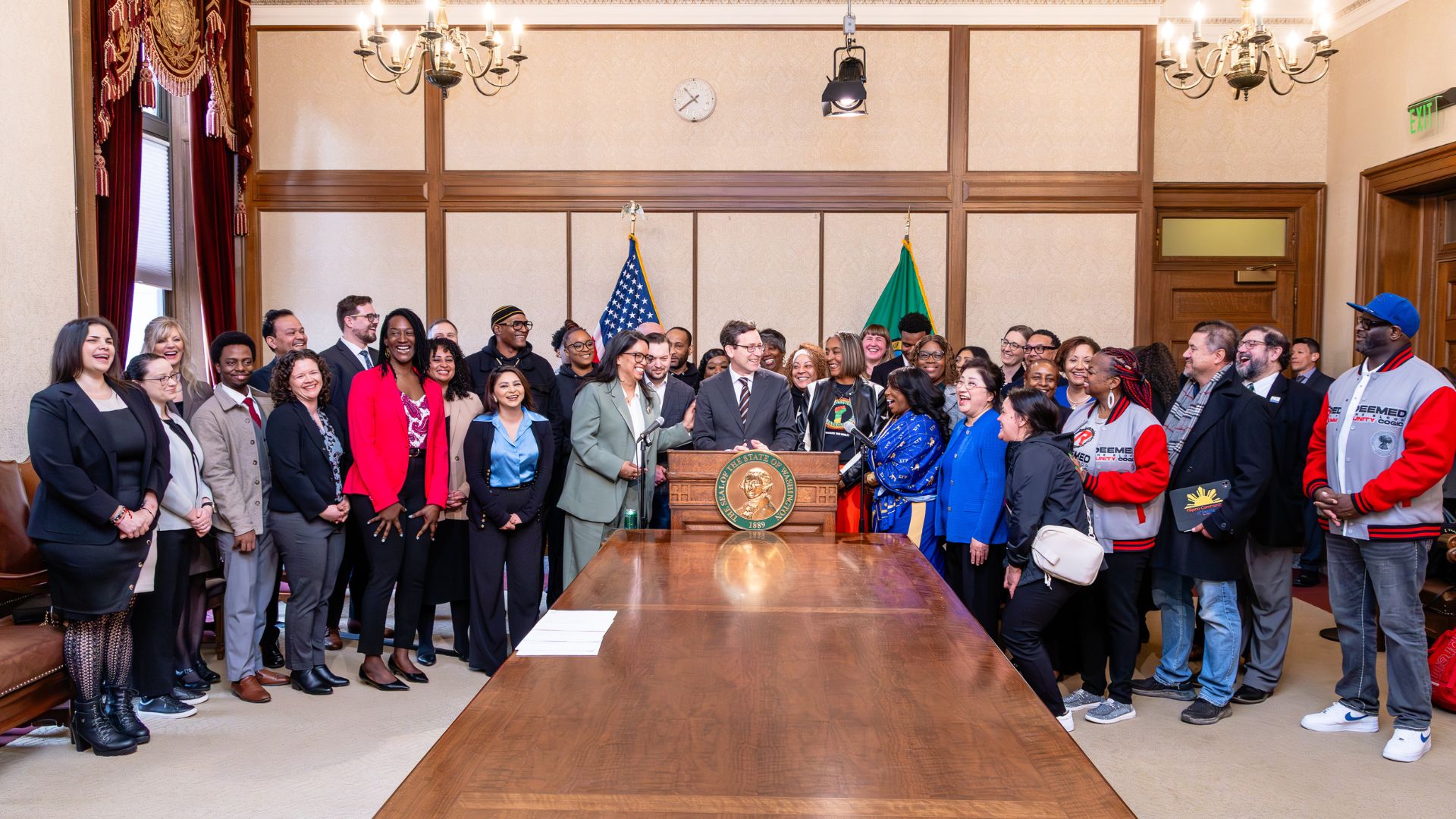
Image: Nick Wagner / The Seattle Times, 2025
Published in the Seattle Times
By the Seattle Times Editorial Board
January 11, 2026
New year, same fiscal conundrum. Washington state lawmakers once again face a legislative session that will be dominated by one task: cobbling together the money to pay for an ever-expanding state budget.
Instead, they should seek ways to live within their means, and discontinue a habit of overspending tax revenues.
Gov. Bob Ferguson’s recent budget proposal is essentially a hole-plugging exercise, relying on revenues from the Climate Commitment Act, and drawing down state reserves, to fund state government through June 2027. Ferguson has also backed an impending bill this session to tax millionaires’ incomes as a way to help put an end to the protracted financial imbalance beyond the current two-year budget cycle.
Legislators now have 60 days to put their own imprimatur on the budget. As they weigh the dollars and cents, they must not lose sight of two painful realities. One, that the state’s cost of living, among the highest in the nation, is crushing many Washington families. And two, that the Legislature, by passing a buffet of last-minute tax increases last year — the largest such hikes in state history — is partly to blame for making this a peculiarly expensive state.
Hard to believe that just four years ago, lawmakers sat on a $15 billion surplus. Some of it — one-time federal COVID-19 relief — was plugged into ongoing programs. And the Legislature’s undisciplined habits led to Ferguson to sign more than $12 billion in quickly passed new taxes last year. Those included a sales tax on services approved in just nine days.
The governor, for his part, is drawing an important line in the sand. He is resisting raising sales, property or business-and-occupation taxes — a signal to legislators that more tax revenue is an unacceptable outcome this year.
Ferguson has also backed a 9.9% income tax on earners making more than $1 million a year, introduced by Senate Majority Leader Jamie Pedersen, D-Seattle. But the governor also insists that a new income tax must be paired with reductions in other parts of the tax code to reduce the burden on Washington families and businesses. That is, should it survive likely challenges in court and at the ballot box. Don’t forget, enough voters sent Initiative 2111 to the Legislature, a measure that banned state and municipal governments from imposing a state income tax. And the Legislature approved it in 2024.
Too many lawmakers complain about a regressive Washington tax code but view tax increases as cash grabs to plug into programs. At a media legislative preview Friday in Olympia, Pedersen added his voice to those insisting tax reductions go along with any increases — a welcome endorsement.
While Ferguson has proposed using $569 million from the Climate Commitment Act to fund the Working Families Tax Credit, the most direct relief would be to cut sales taxes. There’s no paperwork to fill out; just money back in Washingtonians’ pockets.
Some state lawmakers seem to signal that at least for this year, they are aligned with Ferguson. State Sen. June Robinson, D-Everett, chair of the Senate Ways and Means Committee, wisely instructed members not to propose new programs this year.
Legislative focus should turn toward making existing state spending more effective, particularly in education. Efforts proven to boost student performance — especially for kids most likely to drop out — are a good place to start. The governor’s budget restores some of the funding cut last year from Treehouse’s Graduation Success program for foster youth. It also preserves some money to help ninth graders in danger of failing.
Disappointingly, Ferguson proposes to cap funding intended to improve parity between poorer and wealthier school districts. That $100-per-student pullback on Local Effort Assistance will save the state $25 million next year, the governor says. But the hit to spending plans in places like Yakima, which are already struggling, will reverberate into the future.
Arguably, the most important education-related push this session would be starting a robust conversation on how to overhaul the way Washington funds schools. Because, with more districts facing dire financial conditions than ever in state history, the current system clearly isn’t working.
On transportation, Ferguson is prudently leveraging the state’s excellent credit rating to invest in infrastructure — repairing aging bridges and finally funding a direly needed new fleet for the Washington State Ferries, which suffered multiple vessel breakdowns this month.
That said, Ferguson’s reliance on $1 billion from the rainy-day fund is risky. Depleting reserves while shirking the state’s law to produce a four-year balanced budget could lead credit agencies to downgrade Washington’s credit rating. That would drive up costs for similar initiatives the governor may wish to fund in the future.
If it is truly “raining,” as the governor asserts, he must acknowledge it’s time to pull out all the stops to balance the budget, including more scrutiny on state government expenditures and reviving the prospect of furloughs for state workers to weather the perceived storm.
Legislative Democratic leaders often repeat their displeasure with President Donald Trump and the Republican-led Congress’ passage of H.R. 1, the “One Big Beautiful Bill Act,” last year. Cuts in the federal budget will indeed harm the state’s social safety net, as will Trump’s tariff policies in a trade-driven state like Washington.
But that ignores the uniquely high costs Washingtonians face: Soaring housing, energy and food prices are eating through the budgets of state residents and small business owners.
The Times’ editorial board has said many times before and will say it again: Lawmakers have made their own troubles by repeatedly ignoring the state’s own economists’ forecasts and continuously outspending tax revenues. There’s no amount of increased taxes that seem to satisfy the Democratic majority. Even as revenues rise, it’s never enough.
The bottom line for lawmakers cannot be to thrust even more financial hardship on the backs of Washingtonians. Enough is enough.
Editor’s note: This editorial was updated to correct that the Tukwila School District is not among districts that receive Local Effort Assistance funding from the state.