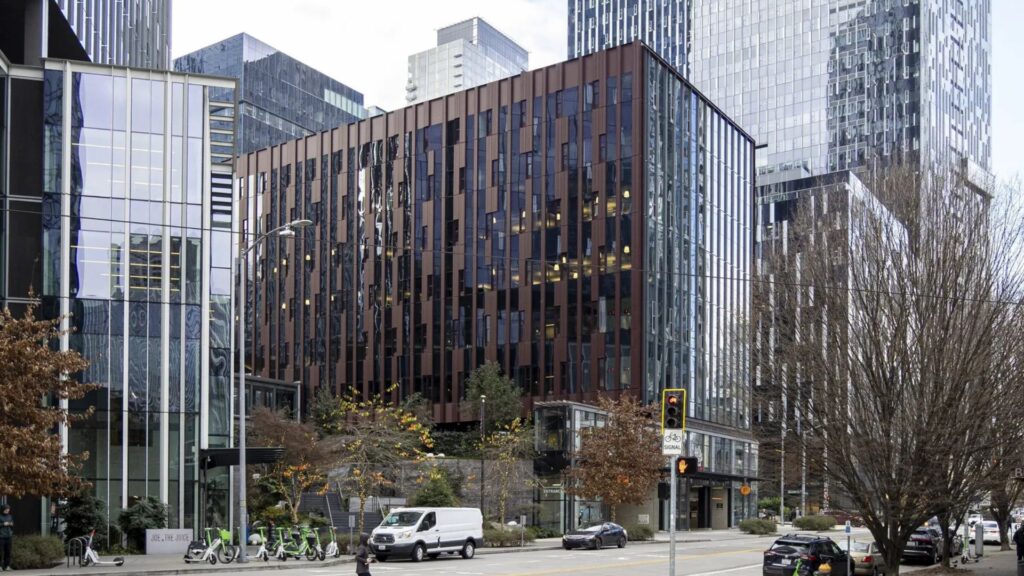
Amazon buildings in South Lake Union in Seattle in January. Amazon, Expedia Group, Meta and Microsoft all reported layoffs, albeit a small fraction of their overall employment, writes the columnist. (Kevin Clark / The Seattle Times)
March 22, 2026
By Alex Fryer
Seattle Times Opinion columnist
In all the hue and cry over taxes in Olympia this year, there was one seemingly overlooked fact.
State lawmakers plugged a budget hole by tapping about $880 million from the state’s rainy day fund, officially known as the Budget Stabilization Account. By law, they were able to access this only-in-emergencies money with a simple majority vote because the state’s employment growth was forecast at less than 1%.
In other words, we’re in for some stormy weather, employment-wise.
You’d never have guessed the job situation was that dire, given all the talk around taxes and spending over the last few months. Most of it centered on how rich people and big businesses would react if and when the tax man cometh for more and more.
The job market sucking wind? Didn’t seem to be much of a priority.
That ought to change.
How about someone in political leadership stepping up to the microphone and saying simply:
“We want businesses to come here. We want them to pay their employees a lot of money. We know every state and region is in competition for good jobs, and we want to win.”
That simple declaration won’t change the world, but it does create a mindset, a philosophical grounding that for all the ills of corporate America — and they are very, very many — it is better to live in a strong economy than one that fails to put food on the table.
To be sure, the economic warning light is blinking red.
In January, the Puget Sound Regional Council reported that the region lost 12,900 jobs last year. Excluding the pandemic, this was the first annual decrease of jobs since 2009 — the depths of the Great Recession.
Remember talk of “green shoots,” President Barack Obama’s garden-inspired phrase to describe tentative signs of recovery? By comparison, we’re seeing dead branches.
Construction, manufacturing and service sectors — which include information technology — experienced the biggest losses.
Reductions in Big Tech got a lot of attention. Amazon, Expedia Group, Meta and Microsoft all reported layoffs, albeit a small fraction of their overall employment.
In an opinion piece published in a union newsletter last month, the head of the state building trades council noted that nearly 9,955 union construction workers in Washington were out of work at the end of last year. That number included more than 1,700 apprentices who were trying to complete their required hours but couldn’t get dispatched to job sites.
Locally, the arts community is also taking it on the chin.
The historic 5th Avenue Theatre, Pacific Science Center, SIFF — the nonprofit that operates the annual Seattle International Film Festival and three Seattle movie theaters — all reported layoffs. Longtime dinner theater Teatro ZinZanni folded its tent.
“Regional employment was significantly impacted by the extraordinary amount of economic uncertainty, created by the trade and immigration policies and the implications of a wider AI adoption,” intoned a report released March 12 by the Seattle Office of Economic and Revenue Forecasts, which noted area employment declined 0.8%.
To hear Gov. Bob Ferguson tell it, we’re doing great.
In his State of the State speech in January, the governor noted that Washington is the ninth largest economy in the nation. It dominates the space industry and has a triple A bond rating, among other positives.
What’s more, Ferguson noted, Washington had the largest increase in requests to form new businesses in the country. The state’s business applications grew 16.2% while nationwide, they dropped by nearly 5%.
“The state of our state remains strong,” he pronounced.
But as reported by the Puget Sound Business Journal, many of these new businesses were started by out-of-work techies who had been laid off. There’s a term for these folks: “necessity entrepreneurs.”
Late last year, the Association of Washington Business released an employers survey that asked: Does your business plan to expand in Washington in the next year or two? Eighty-six percent answered “No.”
Will corporations and wealthy people head for the exits now that the state might have an income tax? I have no idea.
Should an “open for business” attitude include rolling out the red carpet for data centers and other ventures that have serious environmental and other concerns? That ought to be scrutinized, for sure.
But I do know that Seattle and the rest of the state have benefited from many things that are out of our control: deep ports, abundant clean energy, temperate weather, and the good luck of being the place where talented, ambitious people wanted to make their fortunes.
It’s been a long while since we’ve had to work at economic development, a phrase seemingly created to make eyes glaze over.
So let’s start with something simple. A sentiment. A values statement. Something from our elected leaders along the lines of: “We want business here to succeed. We want people to have great jobs. We will do everything to make that happen.”
There, is that so hard?
Alex Fryer: [email protected]. Alex Fryer is a member of The Seattle Times editorial board.