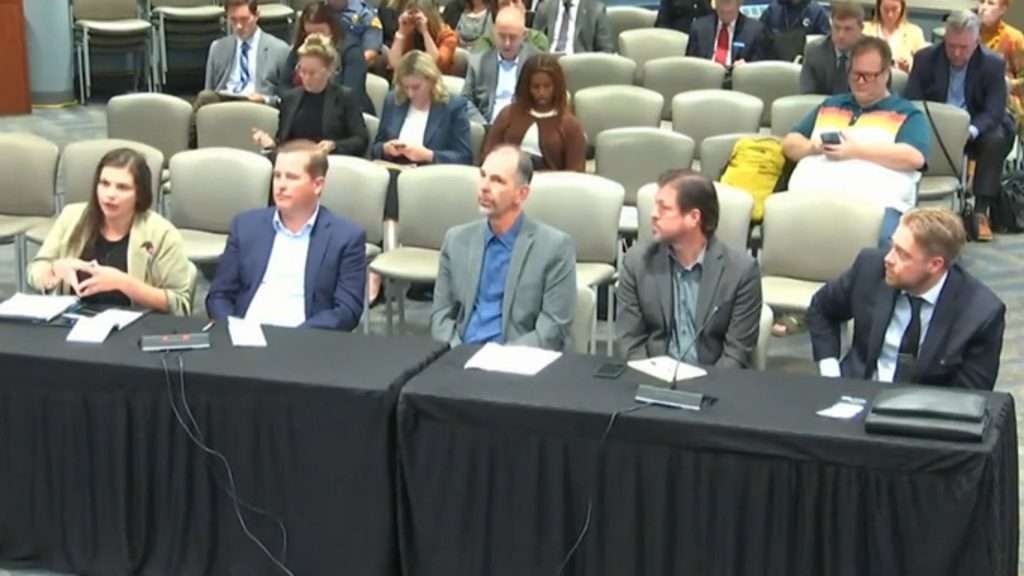
On Tuesday, September 15, the Senate Law & Justice Committee held a work session on gift card fraud and tampering. Washington Retail Association (WR) led the work session alongside the Washington Organized Retail Crime Association (WAORCA), the Gift Card Fraud Prevention Alliance (supported by RILA), The Home Depot, and the Washington Attorney General’s Office to walk senators through how this crime works, what it costs, and what the state can do about it.
Click here to watch the full work session.
What gift card tampering actually looks like
Most people hear “gift card fraud” and picture the phone scam. Someone calls pretending to be the IRS or a utility company and talks a victim into buying gift cards and reading off the numbers. That crime is real, and it does terrible damage, particularly to older adults.
Tampering is something else, and it happens before anyone has bought anything. A crew takes gift cards off the display rack, opens the packaging carefully, records the card number and redemption code, reseals the package so it looks untouched, and puts the cards back where they found them. Then they wait. A shopper picks up one of those cards, loads a hundred dollars onto it at the register, and the money is drained within minutes. Nobody finds out until the card is given as a gift and comes back empty.
An evolving form of organized retail crime
This is the same booster-and-fence structure behind merchandise theft, adapted to a product that moves fast and is far harder to trace than cash. These are not individuals committing petty theft. They are organized crews working from shopping lists, moving between stores and across state lines at high volume.
It is not just happening in Washington. In Kentucky, a grocery store loss prevention officer watched a man returning gift cards to a rack and called it in. Officers stopped the car and found thousands of tampered cards, along with a glue gun, tubs of glue, heating pads, knives, and scales. Four men who had traveled from New York and California were arrested on charges including engaging in organized crime, with the cards valued at more than a million dollars.
The proceeds do not stay in retail. Drained cards are used to buy high-value merchandise in bulk, which move through rented warehouses and are exported overseas. That supply chain turns violent at the far end. In May 2025, a 41-year-old warehouse worker was stabbed to death in a Derry, New Hampshire parking lot in the middle of the day while unloading boxes. Three men had driven up from New York to steal the devices inside. This is a public safety issue, not just a customer service problem.
Federal investigators see the same pattern nationally. Homeland Security Investigations runs an operation focused on card tampering that has seized more than 45,000 compromised cards across at least twelve states and made more than 150 arrests in its first year.
The retail industry takes action
Customers take the hardest hit. These rings found a loophole in existing statutes. A gift card has no value until it is loaded, which means someone caught with thousands of tampered cards has not yet stolen anything the law recognizes as having value. The theft lands later, on a shopper who did nothing wrong and usually finds out at the worst possible moment, when a gift is opened, and the balance reads zero. Roughly one in four American consumers say they have given or received a card that had already been drained.
Retailers have not waited for laws to catch up. The industry has spent years educating lawmakers, training employees to spot tampered packaging, and partnering with state attorneys general to reach shoppers before the holidays, when tampering peaks. Last holiday season, Washington Attorney General Nick Brown filmed a public service announcement with the Gift Card Fraud Prevention Alliance warning consumers what to look for.
That advocacy has moved more than 20 states to introduce gift card legislation, and 12 have enacted laws as of 2026. WR and our partners introduced companion bills during the 2025-26 biennium to close the activation gap and give law enforcement a workable tool. Senator Keith Wagoner, a member of the Law & Justice committee, sponsored the Senate version. Washington has not passed a law yet, but we are hoping that changes in 2027.
Momentum heading into 2027
The senators asked great questions during the presentation and showed a strong desire to get ahead of this emerging crime trend rather than react to it years from now. Several committed on the dais to working together on the issue heading into the next session, and other members signaled they want to help address retail theft more broadly.
Thank you
Our thanks to Senator Manka Dhingra, chair of the Senate Law & Justice Committee, Ranking Member Jeff Holy, and the full committee for making time for this issue. We also want to thank the committee staff who organized the session. They do not sit on the dais, and they rarely get named, but they keep the process running for everyone who engages in legislative advocacy. This work does not happen without them.
Get involved
WR is developing legislative solutions to combat retail theft and organized retail crime. If you want to be part of that work, share what you are seeing in your stores, or help shape our 2027 legislative agenda, we would like to hear from you. Email Crystal Leatherman at [email protected].