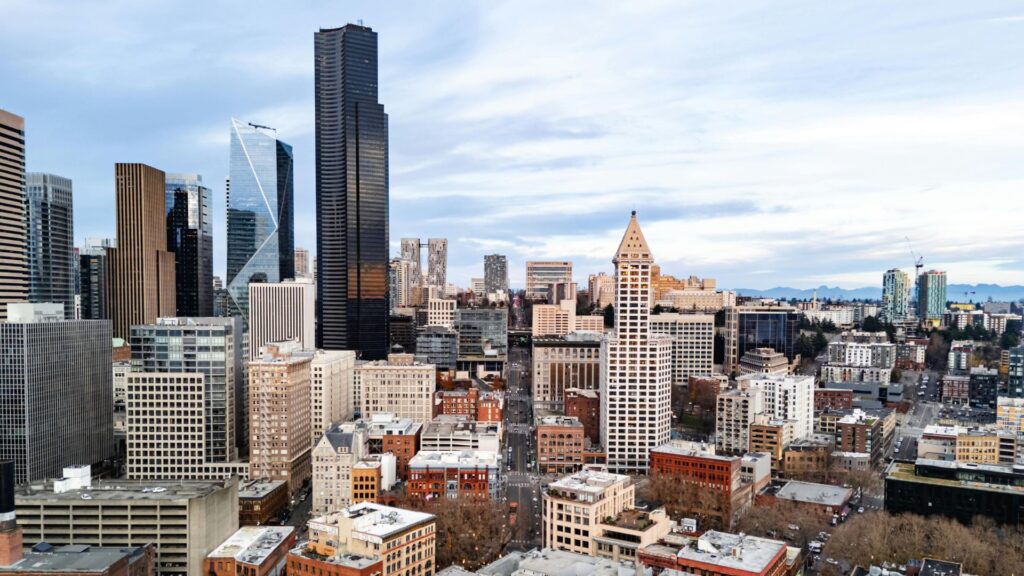
Seattle’s long period of rapid population growth has slowed significantly, according to new estimates from the Washington Office of Financial Management. Between April 2025 and April 2026, the city added about 6,800 residents, bringing its total population to 823,400. That represents a growth rate of roughly 0.8%, a notable decline from annual increases above 2% earlier in the decade.
From 2021 through 2025, Seattle consistently posted strong gains, with yearly growth ranging from 2.2% to 2.7% and net increases of roughly 16,700 to 20,100 residents annually. The latest estimate marks a return to growth levels last seen during the early pandemic period, when the city’s expansion briefly slowed.
The state’s figures differ from federal estimates, which have generally shown more conservative growth for Seattle in recent years. Differences stem from methodology and timing, with state estimates measured as of April 1 and federal estimates typically using July 1 benchmarks.
While Seattle’s growth decelerated, surrounding communities continued to expand, though at varying rates. In King and Snohomish counties, smaller cities and suburban areas saw stronger gains. Stanwood and Carnation each posted growth above 4%, while Gold Bar grew about 3%.
Among larger cities with populations over 10,000, Snohomish led regional growth at about 2.6%, followed by Woodinville at 2.1%. Marysville, Shoreline, and Tukwila also posted modest increases ranging from 1.4% to 1.6%.
In contrast, Bellevue saw minimal change, growing just 0.2% to reach about 158,300 residents. Overall population growth in King County slowed from 1.4% to 0.5%, mirroring Seattle’s broader cooling trend.
Statewide, Washington added approximately 61,200 residents, bringing its total population to about 8.18 million. The 0.75% growth rate marks one of the slowest increases in decades.
Analysts note that immigration has been a key driver of regional population growth in recent years, and recent declines in international migration may be contributing to the slowdown. It remains unclear whether Seattle’s reduced growth represents a temporary shift or a longer-term trend.